
Fruits of the Spirit: Meaning & Full List
The fruits of the Spirit are nine character qualities described in Galatians 5:22-23 that grow in a believer’s life as evidence of the Holy Spirit’s presence. They are not works a person performs, but a natural outcome of walking closely with God.
Paul lists them together as a single “fruit,” not nine separate fruits, which points to one unified character rather than nine skills to master individually. Understanding each one helps a believer recognize spiritual growth in everyday life.
| Aspect | Fruits of the Spirit |
| Bible Reference | Galatians 5:22-23 |
| Written By | The Apostle Paul |
| Total Fruits (Protestant) | 9 |
| Total Fruits (Catholic) | 12 |
| Opposite Concept | Works of the Flesh (Galatians 5:19-21) |
| Related Passage | 1 Corinthians 12 (Gifts of the Spirit) |
What Are the Fruits of the Spirit?
What are the fruits of the Spirit? They are love, joy, peace, patience, kindness, goodness, faithfulness, gentleness, and self-control, listed in Galatians 5:22-23 as the result of a life guided by the Holy Spirit rather than the flesh.
The passage reads in the King James Version: “But the fruit of the Spirit is love, joy, peace, longsuffering, gentleness, goodness, faith, meekness, temperance: against such there is no law” (Galatians 5:22-23, KJV).
Older translations like the KJV use words such as longsuffering, meekness, and temperance, while modern translations render these as patience, gentleness, and self-control. Both describe the same nine qualities.
Historical Background of Galatians
Paul wrote this letter to churches in the Roman province of Galatia, a region in modern-day Turkey, likely around A.D. 48 to 55. The letter responds directly to teachers who insisted Gentile believers follow Jewish law to be saved.
Chapter 5 sits at the heart of Paul’s argument: freedom in Christ is not an excuse for sin, but the setting in which the Spirit produces real, visible change. The fruit passage answers the question, what does that freedom actually look like in daily life?
How Many Fruits of the Spirit Are There?
There are nine fruits of the Spirit listed in Galatians 5:22-23. This is the number most Protestant traditions reference, while Catholic tradition recognizes twelve, adding three qualities drawn from an older Latin translation of the same passage.
The nine are grouped in three sets of three: love, joy, and peace describe an inner disposition toward God; patience, kindness, and goodness describe outward conduct toward others; faithfulness, gentleness, and self-control describe personal character under pressure.
The 9 Fruits of the Spirit List in Order
Here is the fruits of the Spirit list in order as they appear in Galatians 5:22-23, along with the Greek word behind each one and its core meaning.
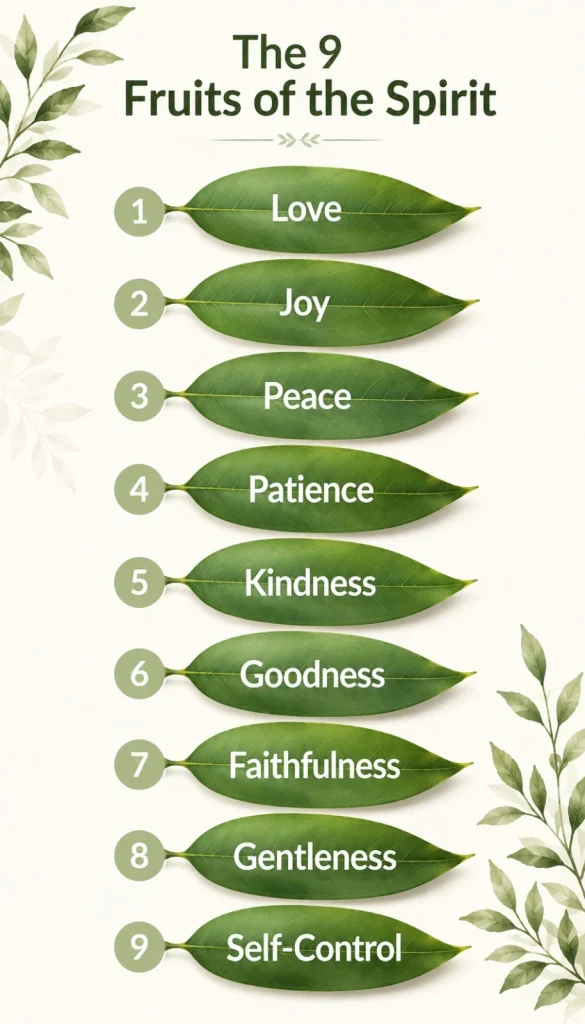
| Fruit | Greek Word | Core Meaning |
| Love | Agape | Selfless, unconditional love |
| Joy | Chara | Deep gladness rooted in God |
| Peace | Eirene | Inner calm and wholeness |
| Patience | Makrothymia | Enduring hardship without giving up |
| Kindness | Chrestotes | Practical warmth toward others |
| Goodness | Agathosyne | Moral integrity in action |
| Faithfulness | Pistis | Steady loyalty and reliability |
| Gentleness | Pratues | Controlled strength, not harshness |
| Self-Control | Enkrateia | Discipline over impulses and desires |
Fruits of the Spirit: Meaning of Each One
Each fruit builds on the one before it, moving from a believer’s relationship with God outward into relationships with others and inward into personal discipline.
Love (Agape)
Love comes first because Scripture describes it as the foundation of the entire Christian life. This is agape love, a deliberate, selfless commitment to someone’s good rather than a feeling based on attraction or reward.
Joy (Chara)
Joy differs from happiness because it does not depend on favorable circumstances. It is a settled gladness that remains present even during suffering, rooted in a secure relationship with God.
Peace (Eirene)
Peace describes a right relationship with God that produces inner steadiness. It reflects the Hebrew idea of shalom, a wholeness that reaches beyond the absence of conflict into genuine completeness.
Patience (Makrothymia)
Patience, translated as longsuffering in the KJV, means enduring difficult people or circumstances without retaliating or giving up. It reflects the same patience Scripture attributes to God toward humanity.
Kindness (Chrestotes)
Kindness turns patience into action. It is a practical, useful goodness expressed through helpful behavior, not simply a pleasant attitude held privately.
Goodness (Agathosyne)
Goodness describes moral integrity, doing what is right even when it costs something or goes unnoticed. It is kindness with backbone, willing to confront wrong as well as comfort others.
Faithfulness (Pistis)
Faithfulness means reliability and loyalty over time. It shows up in kept promises, consistent character, and steady commitment to God and to other people.
Gentleness (Prautes)
Gentleness, sometimes translated as meekness, describes strength brought under control. It is the opposite of weakness, since it takes real strength to respond to conflict without harshness.
Self-Control (Enkrateia)
Self-control is the discipline to restrain impulses and desires that pull against godly living. Paul places it last because it protects and sustains all eight qualities before it.
Fruits of the Spirit vs. Works of the Flesh
Galatians 5 sets the fruit of the Spirit directly against the “works of the flesh” listed in verses 19 to 21. Paul uses this contrast to show two opposite ways of living, one led by the Spirit and one led by sinful human nature.
| Works of the Flesh (Galatians 5:19-21) | Fruit of the Spirit (Galatians 5:22-23) |
| Sexual immorality, impurity, debauchery | Love |
| Idolatry, witchcraft | Joy |
| Hatred, discord, jealousy | Peace |
| Fits of rage, selfish ambition | Patience |
| Dissensions, factions | Kindness |
| Envy, drunkenness | Goodness |
| Orgies and similar behavior | Faithfulness, Gentleness, Self-Control |
Paul warns that those who live by the works of the flesh will not inherit the kingdom of God, while the fruit of the Spirit carries no such warning, since Scripture says “against such there is no law” (Galatians 5:23).
Fruits of the Spirit vs. Gifts of the Holy Spirit
The fruits of the Spirit and the gifts of the Holy Spirit are often confused, but they serve very different purposes in a believer’s life. Fruit describes who a person is becoming, while gifts describe what a person is enabled to do.
| Fruit of the Spirit | Gifts of the Holy Spirit |
| Found in Galatians 5:22-23 | Found in 1 Corinthians 12:8-10 |
| Describes character | Describes ability or function |
| Every believer should show all nine | Believers receive different gifts. |
| Grows gradually over time | Given by the Spirit as needed |
| Measures spiritual maturity | Measures service to the church |
- Key Takeaway: A believer can have strong spiritual gifts without spiritual maturity, but fruit cannot be faked, since it shows up naturally in daily character over time.
How to Grow the Fruits of the Spirit
Scripture describes this fruit as something the Holy Spirit produces, not something achieved through willpower alone. A few practices consistently support its growth.
- Stay in Scripture daily: Regular reading keeps a believer’s mind aligned with godly character.
- Pray consistently: Prayer keeps the relationship with God active, which Scripture ties directly to bearing fruit.
- Practice one fruit at a time: Focusing on a single quality, like patience, builds it more effectively than trying to change everything at once.
- Stay connected to community: Fruit like kindness and gentleness is tested and strengthened through relationships with other people.
- Expect gradual growth: Fruit takes time to ripen, and setbacks do not erase genuine spiritual progress.
FAQs
What are the fruits of the Spirit?
The fruits of the Spirit are nine character traits listed in Galatians 5:22-23: love, joy, peace, patience, kindness, goodness, faithfulness, gentleness, and self-control. They represent the natural result of a life led by the Holy Spirit.
How many fruits of the Spirit are there?
There are nine fruits of the Spirit in the Protestant tradition, based on Galatians 5:22-23. Catholic tradition lists twelve, adding modesty, chastity, and generosity from an expanded Latin Vulgate reading of the same passage.
What is the difference between fruit and fruits of the Spirit?
Galatians 5:22 uses the singular “fruit,” suggesting one unified character made of nine qualities rather than nine separate fruits a person picks and chooses. Both phrases are used interchangeably in everyday speech.
Where in the Bible are the fruits of the Spirit found?
The fruits of the Spirit are found in Galatians 5:22-23, within Paul’s letter to the churches of Galatia. The surrounding verses contrast this fruit with the “works of the flesh” listed just before it in Galatians 5:19-21.
Can a person grow the fruits of the Spirit?
Yes, though Scripture describes fruit as something the Holy Spirit produces rather than something achieved through willpower alone. Prayer, Scripture reading, and staying close to God are described as the means through which this fruit grows.
What is the greatest fruit of the Spirit?
Love is widely considered the greatest fruit of the Spirit, since Scripture describes it as the source from which the other eight naturally flow. First Corinthians 13 also names love as greater than faith and hope.
What is the difference between fruits and gifts of the Holy Spirit?
Fruit describes godly character every believer should display, such as love and patience, while gifts describe specific abilities, such as teaching or healing, given to different believers for serving the church.